Monday, March 7, 2011

The Plow.

     The Plow (also spelled 'plough') is a very ancient and important tool in farming. As the ground thaws and planting time approaches the farmers of Owyhee County will put them to good use.


     This is what we call a four-bottom reversible plow. Each of the shiny bits is a single plow, there are eight of them here. Four-bottom means that when the plow is working, four individual plows will be in the ground at a time. Reversible means that this plow flips over on a hinge at the left of the picture. As you can see the plows on the top and the the plows on the bottom point in the same direction. This might not make sense right now but the reason will be explained later.
     What a plow does is roll the soil over. By lifting up the nutrient rich soil and putting it on top it allows for more productive crop growth. By dropping the tired soil underneath with all the plant material it gives time for this soil to recover. All the plant material that is buried becomes food for the many microorganisms that live in healthy soil. The microorganisms break down the plant material back into the nutrients that, in time, the plow will bring back to the surface to be used once again. If you refer to the picture above you can see all the working parts of a plow. The point (called the chisel) begins by breaking the soil and the part directly behind it (called the share or ploughshare) cuts into the soil and lifts it. On top of both of these is the large curving piece of metal (called a mouldboard) that lifts and rolls the soil over inverting the layers. The process leaves a ditch in the ground which is called a furrow. The next plow in the line tosses dirt into the furrow of the plow in front of it.


     In order to keep tossing the dirt in the same direction the plows must always point the same direction. This is where the reversible part of the plow comes in. When the tractor is turned around, the farmer will also flip the plow over and the mouldboards will be pointed correctly to toss their soil in the right place. Keep in mind that there are many kinds of plows and quite a few are used here in Owyhee County. This is only one of them but they all do the same thing.

    
      By turning the soil and leaving the plants roots-up the plow makes farming far more productive. This means more (and cheaper) food for you, the public. So no matter who you are, your life is made better by the plow, which is pretty neat if you ask me.

Friday, March 4, 2011

Cows and Calves.

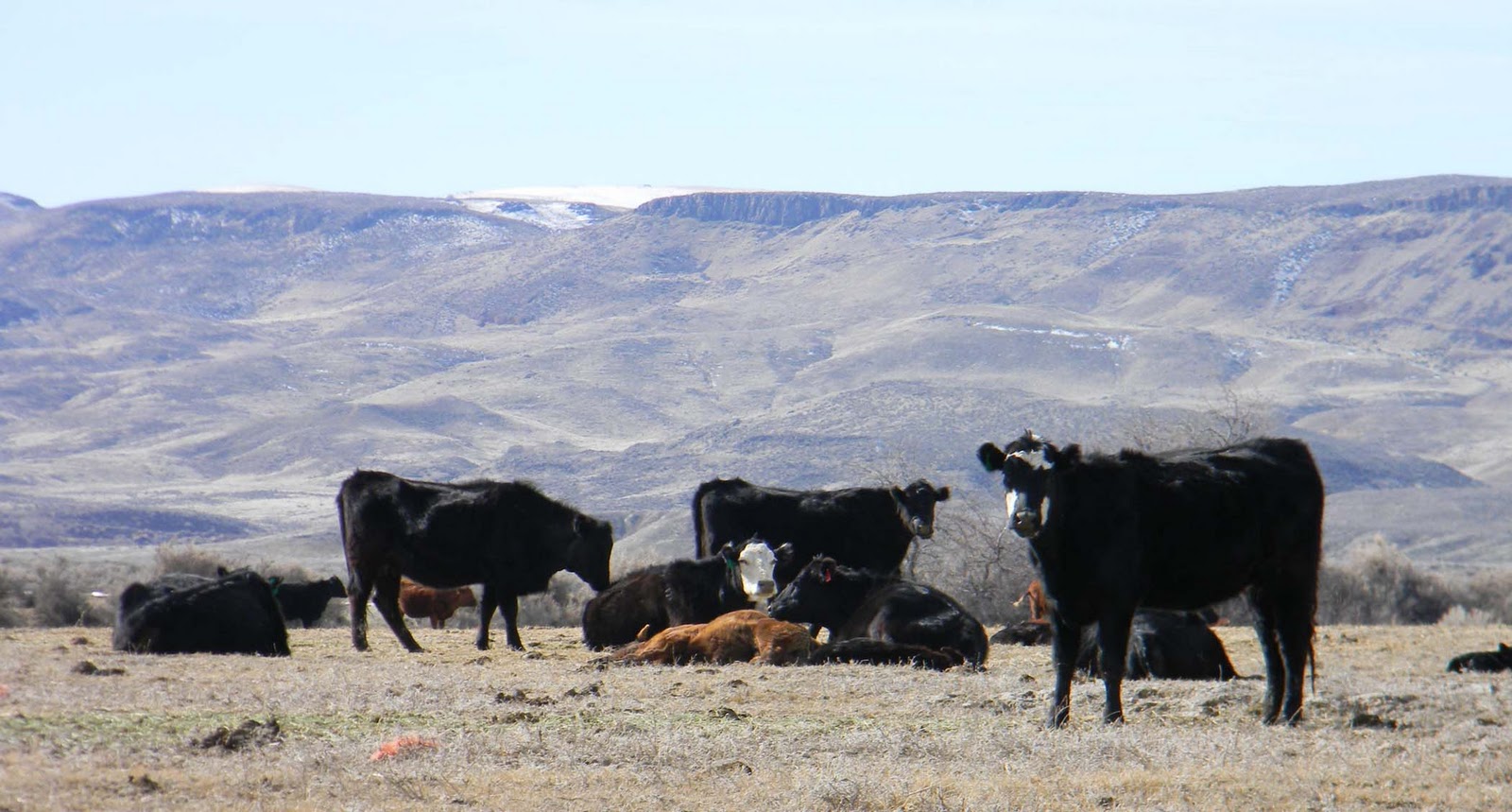
     By far, the most numerous stock animal in Owyhee County are cattle. Today, I'll be talking about beef cattle as opposed to dairy cattle. It's calving time! Those of you with a keen eye for patterns will realize immediately that calving means: The time when calves are born.


     Often people will refer to cattle in general as cows. This is often incorrect as cow refers only to female cattle and usually only those of breeding age. At any rate the picture above is full of cows. They don't do much, but what they do they are very good at. First and foremost they can live and thrive off of plant material that we cannot. This allows them to effectively gather resources in places we could not, namely the hills and mountains. Cows are also good at making babies.


     A cow's baby is called a calf. Each cow can produce one and sometimes two in a year, though most beef cows will have difficulty raising more than one at a time. A cow will nurse and protect her calf for several months until the calf is strong enough to feed and protect itself, but for now, they mostly just lie around waiting for the next feeding time.


Thursday, March 3, 2011

The Crowner


     This sturdy looking piece of equipment is called a Crowner. Those of you who read the earlier post on alfalfa might remember that the "crown" is the part of the plant where the root and stems meet. This part of the plant is just under the ground, and the crowner's purpose is to cut it. Farmers do this to remove the alfalfa to make room for other crops.


     It's as simple as it looks. It's a platform for three massive V-shaped blades that are pulled through the ground. As you may be able to tell by the picture it can take quite a bit of tractor to do it. This particular patch of alfalfa is being removed to make way for spring wheat.


     Surprisingly, a few alfalfa will survive this. Some will be pulled up out of the ground and then the roots will grow back down, others may just slip around the edge of the blade, but for the most part the blade removes most of the plants. Once the crown is severed from the root, the alfalfa dies. It's nutrients will be returned to the soil to feed future crops.


Wednesday, March 2, 2011

Rams, Ewes, and Lambs.

     It's lambing time! For those of you with little exposure to sheep, that simply means: The time when the lambs are born.


     A part of the ranching industry here in Owyhee County is dedicated to sheep. They spend the warm months grazing in the hills and the cold months in pens. Sheep are raised for meat and wool. A group of sheep is called a herd, mob, or flock. A typical herd of sheep is made up mostly of females, called ewes, (pronounced "yew") with just a few males, called rams. Their only real job is to get fat, grow wool and birth lambs.


    A ram (pictured above) is mostly responsible for fathering lambs. While most of the protection of the herd is handled by the sheep dogs and shepherds the ram can still hold his own if need be. The shepherd will pick the best rams to keep. The rest will be sold or castrated. These sheep, called wethers are useful for meat and wool, but will not interfere with the ram's work.


     A ewe (above again) can give birth to one, two and sometimes even three or more lambs. The lambs will grow quickly and will only need to nurse for a short time. This allows the ewe to regain her health completely before the winter comes. A ewe will be able to raise lambs every year for most of her life.

(For the adults)
     While it may seem that the sheep industry is a simple one, nothing could be further from the truth. Like all agriculture, it is time-consuming and hard work. A sheep is vulnerable to disease, poison, predators, and a host of other problems. And the infrastructure and overhead of the business can be crippling to the industry. I urge you to support your local shepherds, if indeed there are any left in your area. Prepared correctly, the meats are some of the very finest. And whether or not meat is your thing, wool is a tried and tested fabric that is tough and warm. Get some today! Okay maybe not today... But remember! When your money goes to a local producer, some of it may come back to you when they spend some money at your business.

Tuesday, March 1, 2011

Waking up.

     The end of winter is in sight! About a week ago I talked about the wheat. Well today is about the next crop to wake up: the Alfalfa. Alfalfa is a perennial. Perennial means that it can grow year after year from the same base which is called a crown. And a bit more than a week ago, this is what it began to do.


      It starts slow at first, with just a few leaves popping straight out of the crown. Soon it will grow into a small shrub, and can grow to about 3 feet tall.
      Alfalfa's primary use as a crop is as feed for livestock. This allows for two industries. The first grows the alfalfa for livestock feed, and the second grows alfalfa for the seeds that the first industry uses to grow their crop. Here in Owyhee County we have both.